
Charlotte Cato College Of Education Is Blessed With 2026 Retiring Faculty
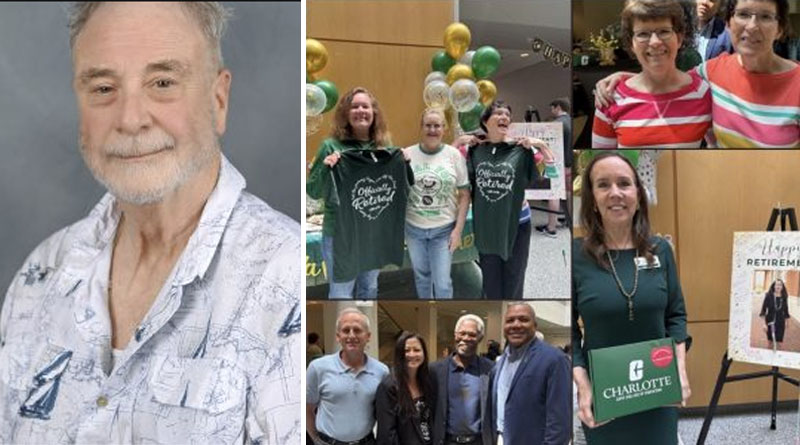
UNC Charlotte Cato College has an exceptional class of retiring faculty this year, with countless publications, dozens of awards and over 100 years of teaching experience between them. Many thanks to Jack Culbreth, Warren DiBiase, Dawson Hancock, Charles Hutchison, LuAnn Jordan, David Pugalee, Rebecca Shore, Shawnee Wakeman, and Chuang Wang for their years of dedication and service — all will be deeply missed, and their impact will be felt for many years beyond. Cato College has been blessed to have such hardworking experts as part of the team for so long, Charlotte wishes them well in their well-earned retirement.
Several of these storied educators had some parting thoughts to share about their work and the impact they have left on the college. From their entry into education to the work they’ve contributed to the field at large, this is just a handful of their stories worth sharing.
Charles Hutchison
Charles Hutchison joined UNC Charlotte back in 2003, working 23 years for the university. When he was hired, the school was undergoing an identity transition, and he was excited to be a part of several initiatives that helped it become what it is today. As part of these initiatives, Hutchison participated in discussions on the UNC Charlotte faculty council to help retain students on campus over the weekends. Along with his work on the faculty council, he was able to cultivate lasting relationships through collaborations with different college units. These included the Center for Teaching and Learning, Department of Africana Studies, Office of International Affairs, African and African-American Faculty and Staff Caucus (as the chairman), and Phi Beta Delta Honor Society for International Scholars (as the president).
Hutchison is originally from Ghana, where he graduated college. He studied science, specifically zoology, botany and chemistry. He landed on zoology as his official major in his final year of college, choosing it “because it was known as one of the hardest majors in the university at the time, and so it was cool to be one of the ‘smart’ guys.” He worked for several years as a laboratory scientist in immunogenetics in Hungary, then later in the United States. It was here in the U.S. where he began teaching high school science, before being urged by friends and family to, like his father before him, become a professor.
When asked about his proudest accomplishments as a professor, he replied, “As an African, I come from a tradition where professors are expected to profess ‘deep knowledge.’” Aside from publishing several books/articles, working as editor and chief of a journal, and his work being featured in the Times Higher Education, his proudest personal accomplishment as a professor was when his students noted he had taught in ways that challenged their thinking so much he “broke” their brains.
Hutchison is leaving a legacy of effort made toward what is now the largest doctoral program in the university, the urban education concentration of the Ph.D. in Curriculum and Instruction. He also was an active advocate for his fellow Niners, whether faculty, staff, or students. “As the chair of the African and African American Faculty and Staff Caucus, I contributed in working with then Chancellor Dubois and Provost Joan Lorden to address the issues facing faculty and staff of color on campus—including promotion, tenure, and retention issues—as well as the needs of students of color, especially as the demographics of the student population was changing.”
Shawnee Wakeman
Shawnee Wakeman has been teaching for 30 years, spending a whopping 21 of those at UNC Charlotte. If you asked young Wakeman what she wanted to be when she grew up, professor was always her top choice — she even said so in her high school yearbook. In fact, it was during high school that she worked as a camp counselor for disabled children, which showed her how much she loved working with and supporting them. This led to her areas of study as a researcher: general curriculum access, alternate assessments and inclusion of students with extensive support needs.
While at UNC Charlotte, she helped to change the dynamic and opportunities of clinical faculty and recognize them for their efforts and accomplishments. As said by Wakeman, “[Former Dean] Mary Lynne Calhoun was always willing to let me take on a new challenge if I asked. She supported our original efforts to create a promotion process for clinical faculty that we enjoy today.” She also leaves behind a strong legacy of research: “The research we were able to do and the technical assistance we were able to provide has significantly impacted the lives of students with disabilities and their teachers.”
Wakeman loved the opportunity to support her students in their journeys to become special education teachers. Her program has produced many award-winning teachers, including the NCACTE Beginning Teacher of the Year winner in 2026 and runner up in 2025. She shared, “Just as impactful to me are the students that worked so hard to finish the program when there were so many obstacles along the way. Their perserverance inspired me. I will miss teaching and engaging with my students.”
When asked about how she views her impact on the college, Wakeman answered, “Helping to shape future educators is a gift I was given. They impact the future. I also think my federal grants and centers with all the resources continue to impact teachers and students through dissemination. I hope the clinical faculty in the Cato College of Education and the university continue to thrive and push for opportunities and change to showcase the expertise and value they represent.”
Warren DiBiase
Warren DiBiase began his career at UNC Charlotte in 1997, nearly 30 years ago, when he was appointed assistant professor of middle/secondary education. Before then, he taught high school juniors and seniors, and even considered becoming a principal at one point. It was actually the path to principalship that eventually led him to Cato College. While earning an M.S. in secondary education, one of his professors asked him to stay after class. What he said changed the trajectory of DiBiase’s career, professing that his writing was doctoral student quality and urging him to pursue a doctorate.
DiBiase decided to do just that while continuing to work in high school education. This presented an issue, as the college where he wanted to pursue a doctorate was two hours away, and the doctoral committee wanted to reject him: they had never had a part-time doctoral student before. That was when one committee member, Patricia Obenauf, stood up for him. DiBiase shared, “She did not know me or anything about me and unconditionally spoke up in support of me, convincing the other committee members that it could be done and she was certain that I would be successful and earn a doctorate.” After the completion of his degree, he decided not to return to his role as principal, and instead found an assistant professor position at UNC Charlotte.
When asked what his greatest accomplishments were at UNC Charlotte, his immediate instinct was to focus on his students. “Being told I was the best professor they ever had,” he said. Second to this was a research collaboration with Todd Steck, a microbiologist and biology professor, and Helene Hiller, a civil engineering professor, to write a NSF FIPSE grant, with DiBiase as the primary researcher. He distinctly remembers sitting in his office one afternoon: “I got a call from the NSF, they were going to award us the three-year, half a million dollar FIPSE grant!”