
Gaber Has Charlotte’s Endowment Up 90%, And A Plan To Move UNCC To The Top Of Universities
By: JENNIFER HOWE
Photos by: AMY HART
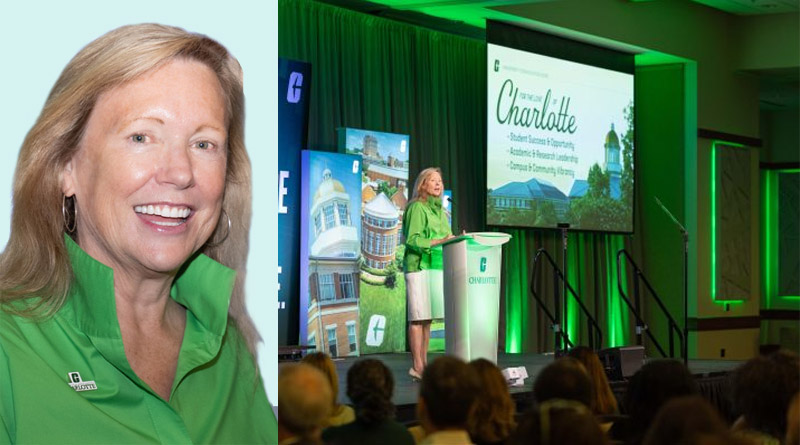
UNC Charlotte opened the 2026‑27 academic year at University Convocation on Thursday, Aug. 13, where Chancellor Sharon L. Gaber, Provost Jennifer Troyer and Vice Chancellor for Research John Daniels outlined record achievements, strategic priorities and new opportunities that position the University for continued national ascent.
A strong start: growth, recognition and a refreshed strategic plan
Gaber said Charlotte enters the academic year in a “strong position,” citing its first full year as an R1 research university, expanded academic programs and new student success milestones. She highlighted the University’s leadership of the NSF Grid Modernization Engine, which could bring up to $160 million over the next decade.
Fundraising momentum continues. The For the Love of Charlotte campaign has surpassed $427 million, growing the University’s endowment from $226 million when Gaber arrived to $428 million today — an increase of about 90%.
Gaber outlined the refreshed strategic plan and its most ambitious goal, Project 50/30, which aims to position Charlotte among the nation’s top 50 public universities by 2030.
She also announced the creation of a new School of Energy, led by founding director Rob Cox, executive director of UNC Charlotte’s Albert & Freeman Energy Production and Infrastructure Center and the Duke Energy Distinguished Scholar in Power Engineering Systems, to unite University expertise and prepare the workforce needed to modernize the nation’s electric grid.
Academic priorities: student success, graduate growth and AI leadership
Troyer emphasized Charlotte’s mission to transform students’ lives and noted strong enrollment momentum. The University is on track to welcome more students than last fall’s record 32,207, including more than 5,100 first‑time college students, over 3,000 transfer students and over 2,000 new graduate students.
To meet workforce needs, Charlotte has launched six new or expanded fully online programs — including computer science, criminal justice, economics, special education, early childhood education and intervention and an M.A. in Spanish — along with new in-person AI programs and a B.S. in construction engineering. The University is also welcoming 100 new faculty members this academic year.
Troyer outlined three academic affairs priorities:
- Charlotte Model for student success, a comprehensive approach that includes professional advising, peer mentoring, financial literacy and experiential learning.
- Graduate student growth, including raising doctoral stipends to the national median and opening graduate housing at Niner Woods.
- AI leadership, with 11 academic programs now carrying AI in the title and 117 courses including AI in the course title or description — a 50% increase over last fall.
Research enterprise: candid challenges, major momentum and new opportunities
Daniels said that Charlotte is well‑positioned for growth. Key opportunity areas — energy, AI, defense and life sciences — align with University strengths, and bipartisan support for federal research funding remains strong.
Daniels highlighted faculty excellence and major partnerships such Charlotte AIR Institute’s collaboration with Charlotte Douglas International Airport and the FAA to develop the nation’s only runway digital twin. He described the recent NSF Grid Modernization Engine in the Carolinas as building the “Silicon Valley of grid modernization,” uniting industry, academia, government, entrepreneurs and venture capital.
Daniels also announced that facilities and administrative funds will again be distributed to PIs, departments, colleges and centers.
A unified message: acceleration, optimism and shared purpose
All three leaders emphasized that Charlotte’s momentum is accelerating. As the University approaches its 80th anniversary in September, they called on faculty and staff to work together to strengthen student success, expand research impact and elevate Charlotte’s national profile.