
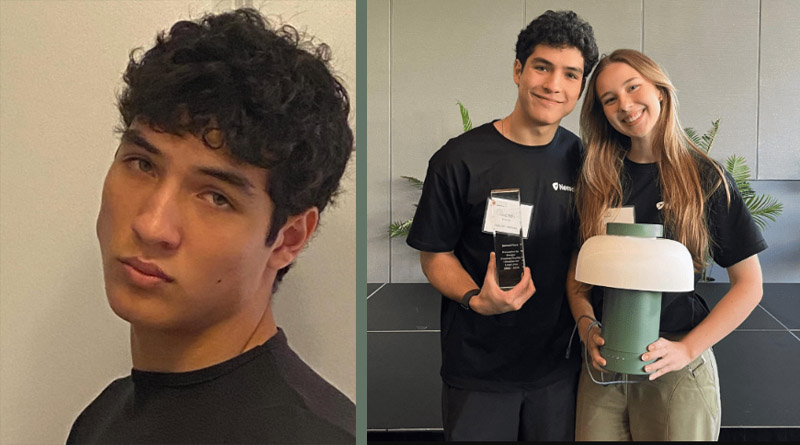
Charlotte Innovator Andrei Vince Soars At Global Competition With Neevel, A Project To Help Prevent Older Adults From Falling
A research team that included Andrei Vince, a third-year UNC Charlotte computer engineering major, placed second in the Stanford Center on Longevity Design Challenge finals with Neevel, a fall prevention project for older adults. The competition drew 249 entries from 33 countries. Vince’s team was the only finalist from North Carolina.
“Placing second at Stanford was extremely validating because Neevel was evaluated by people who work directly in aging, longevity, venture capital and health innovation,” Vince said. “For me, it confirmed that fall prevention is not only a technical problem — it is also a design and adherence problem, and Neevel’s approach has value beyond the competition.”
Designing a screen-free system
Neevel is a screen‑free fall‑prevention system designed to support aging adults without the use of smartphones. It combines sensor insoles that quietly track how a person walks with a small hub that works as a nightlight, voice-guided balance coach and progress tracker. Vince co-founded Neevel with Verônica Vanti, the project’s lead product designer and an industrial design student at the Federal University of Rio Grande do Sul in Brazil.
Vince and Vanti are childhood friends, and went to high school together in Porto Alegre. The inspiration for Neevel came from Vanti’s grandmother, who had a serious fall and temporarily lost part of her independence.
“That made the problem very personal for us,” Vince said. “We started asking why so many fall-prevention solutions fail in real life, and the answer was not just a lack of technology. It was that many solutions feel clinical, inconvenient or dependent on a smartphone.”
Vince, the project’s lead engineer, built the sensor-equipped insoles and the AI device that works without Wi‑Fi that processes gait data, guides users using voice prompts and light cues, and updates a companion app for family and clinicians.
Vanti led the overall product design, the user-centered narrative and wrote the pitch. Vince says her design instincts are why Neevel feels like an everyday object rather than a medical device, which was central to the judges’ feedback.
“Working with her was one of the highlights of the project because we brought different strengths to the same problem,” Vince said. “Neevel only worked because both sides came together: the engineering and strategy to make it real, and the design judgment to make it human.”
Neevel’s next steps
Vince and Vanti presented to a panel of seven experts in aging and longevity and were judged for their designs’ impact, originality, feasibility and affordability. Their second place finish earned them a $5,000 prize that will go toward continued prototype development, additional sensor and hardware materials, user testing and early legal and research steps as the team explores Neevel’s next phase. Conversations with longevity-focused venture capitalists and AgeTech ecosystem leaders led to new opportunities for Neevel. The team is now considering filing a provisional patent on the closed-loop gait screening and intervention system.
“What made the trip even more meaningful was that it started meaningful conversations beyond the competition itself,” Vince said. “Several people connected to venture capital and the aging‑tech startup community encouraged us to keep building Neevel as a company, which made the result feel like more than just a one-day placement.”