
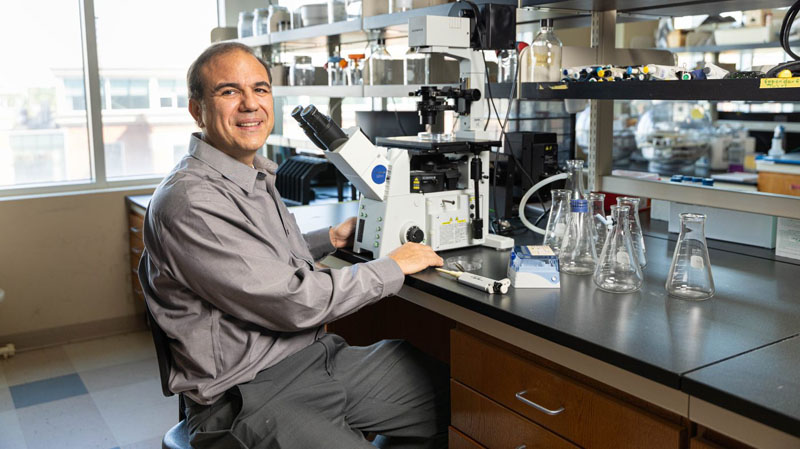
National Award-Winning Biomedical Researcher Angelo Gaitas Selects UNC Charlotte As Home
Angelo Gaitas is pioneering a path to understand heat production and heat flow within single cells and tissues. Recently armed with the prestigious NSF CAREER Award, he is developing a precise, microscale device, the world’s first device that measures how efficiently heat is conducted inside cells, i.e., local thermal conductivity.
Rather than acting as a simple thermometer, the sensor infers local thermal conductivity (using established electrical heating/sensing techniques) which can be used to estimate relative intracellular heat‑flow patterns in select experiments.
By measuring at this level, the researcher can quantify how heat is transported and dissipated, then examine how the physical properties correlate with metabolic activity, enzyme dynamics and signaling. “Those insights could inform diagnostics and help refine temperature‑based therapies,” said Gaitas, UNC Charlotte’s newest biomedical engineer and associate professor of electrical and computer engineering.
Using micro biosensors, Gaitas’ research aims to enable more accurate analyses of conditions involving heat and may help refine treatments like cryotherapy and hyperthermia. Meanwhile, the studies will improve the understanding of disorders in which cellular energy use and heat transport are disrupted.
Gaitas relocated to Charlotte for its distinctive advantages.
“The research opportunity is so diverse in Charlotte. In addition to translational work that supports specific disease studies, the University also prioritizes foundational research that allows me to develop practical tools that apply to human health more broadly. When you add the strong talent in the engineering college with the smooth processes and commercialization opportunities on campus, Charlotte was clearly my new home.
“Beyond campus, Charlotte is a wonderful city with economic growth and tremendous potential, and the State of North Carolina actively supports biomedical and high tech industries.“
A huge challenge of the smallest proportions
A physicist and engineer by training, Gaitas became fascinated with the intricate processes within single cells, describing the cell as “a finely engineered factory — dense, dynamic and exquisitely organized.” This led him to the critical question of how heat is generated, conducted and regulated — and how it is used and transferred — within these biological factories.
The biggest challenge he faced was the lack of tools capable of measuring key physical quantities (like heat transport) inside a cell. This obstacle fueled his inspiration to design, develop, and deploy precision, micro‑sized instruments, ultimately shaping a career in biomedical engineering.
Opening factory windows to reveal medical benefit
With support from NIH and NSF, and now at Charlotte’s William States Lee College of Engineering, Gaitas is developing nanoscale and microscale sensors, including microthermometers and fluidic microcantilevers. These inventions allow researchers worldwide the ability to quantify temperature, mechanical properties, growth/mass changes, and electrophysiology in single cells, revealing how physical forces, energy use and drug responses influence cellular behavior.
As Gaitas begins at Charlotte in September, the William States Lee College of Engineering expands its research expertise and teaching depth in the biomedical field. “We are thrilled to welcome Dr. Angelo Gaitas to UNC Charlotte,” said Asis Nasipuri, associate dean for faculty affairs. “With over two decades of innovative academic and industry experience in micro- and nano-devices for biomedical applications, he will provide our students with valuable opportunities to develop cutting-edge bioinstrumentation solutions for today’s most pressing health care challenges.”
From his lab in Charlotte, Gaitas is opening quantitative windows into the dynamic cellular factory, producing strong potential for medical benefit — from basic biology to better diagnostics.