
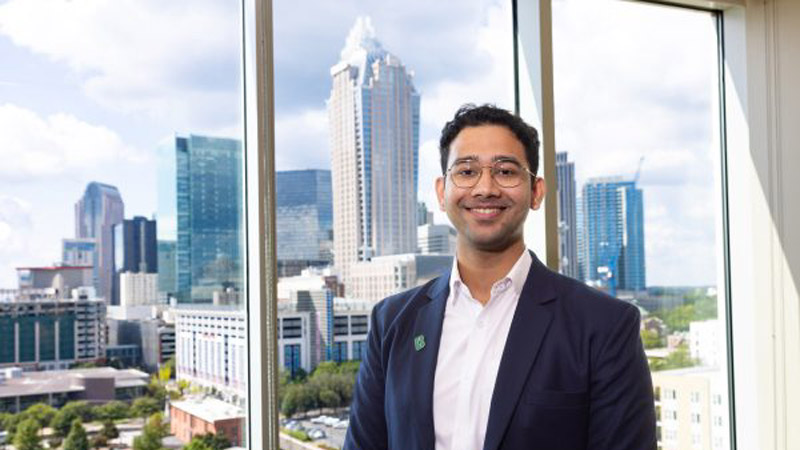
Charlotte Ph.D. Grad Asks: What Are the Consequences Of AI Changing Life As We Know It?
Sri Yeswanth “Yash” Tadimalla knows what the future could hold: a world where people live in harmony, where technological advancements are the surging tide that raises the impoverished into prosperity and the hungry into comfort while empowering the voiceless. He knows it’s possible, but also acknowledges that it’s going to take a bold vision, collective commitment and plenty of hard work to make it happen.
Not everyone believes they can change the world for the better, especially in the face of sweeping societal changes brought about by the widespread implementation of artificial intelligence technologies. But Tadimalla is a true representative of Niner Nation’s can-do attitude, crediting his fellow 49ers with giving him the confidence to dream big and boldly in pursuit of a better tomorrow.
“This university has so many great people who are doing amazing things,” Tadimalla said.
Receiving a Ph.D. in software information systems and sociology this summer, Tadimalla has been hard at work creating a roadmap of sorts to explain and understand the various drivers of the current AI landscape through the idea of a human-AI interaction “ecosystem” and “AI Identity” as shaped by societal ideas and priorities around tech development and philosophies around its design.
As AI technologies become more powerful and more intertwined with our lives every single day, its potential to be used for tremendous good or as a tool to further divide is growing exponentially. Through Tadimalla’s work, he hopes to carry the torch of his academic mentors forward in helping the world better understand AI in all its complexity to both enhance its ability to benefit lives and prevent the perils of its potential abuse.
“Who is creating this technology and who is influencing it? What is the infrastructure needed for developing and understanding AI, and what are the socio-technical frameworks shaping the technology? What are the consequences and considerations of how AI is changing life as we know it?
“These are the questions I’m working toward answering,” Tadimalla said.
The power of tech
Hailing from India, Tadimalla grew up in Hyderabad. He lived in the bustling city most of his youth, but often spent his summers visiting his grandparents in the rural farming community of Kovur and Machilipatnam. Tadimalla’s father is a business executive in the fields of infrastructure development, business expansion and legal compliance, and his mother was a former public relations expert who chose to become a homemaker during his childhood.
Tadimalla was drawn to technology from an early age. He was entranced by video games and also used computer programs as creative tools. He loved expressing himself through the classic Paint program on Windows, and would make PowerPoint slide presentations filled with rudimentary animations and movie recordings.
He learned quickly that technology isn’t just something fun to play with — it’s something that could dramatically change people’s lives in ways that couldn’t have been previously imagined.
“I grew up at a time when the impact of computing was really clear in India,” Tadimalla said. “I saw firsthand the economic development that came with technological advances. That ability to empower strongly resonated with me.” At the time, he hoped to one day start a tech company of his own as an entrepreneur, thinking that striking out into the technology business was the best way he could make a positive mark on the world.
First, Tadimalla studied computer engineering at the Hyderabad Institute of Technology and Management. In the classroom, he honed the computing skills he felt he’d need to make an impact in the world of tech. But it was outside the classroom — particularly on a United Nations volunteer trip to Sri Lanka — where Tadimalla first started to feel the pull toward committing his life to helping others and humanitarian causes.
“It was incredible,” he said. “That experience really made me realize the importance and value of being a global citizen.”
Tadimalla initially only planned to get his master’s degree before embarking on a career as a tech entrepreneur. He knew that leaving home to study abroad was the best way to broaden his horizons and gain the breadth of experience needed to truly follow his dreams.
It wasn’t just the school’s reputation for excellence in computer science that swayed Tadimalla to apply to UNC Charlotte for grad school — he was also thrilled at the prospect of living in a thriving, growing business powerhouse like Charlotte and about the chance to live near close relatives in North Carolina.
It all added up to a clear choice for Tadimalla. He proudly joined Niner Nation and the College of Computing and Informatics in pursuit of his M.S. in computer science with a concentration in data science.
While working toward his master’s, Tadimalla began getting more and more involved on campus over time. “I basically have done every job you can do in the Student Union,” he said, reminiscing on his experience working in event organization, at the information desk and other part-time jobs that helped him realize how much he loved connecting with fellow students.
Soon, he dove into advocacy for graduate students through the Graduate and Professional Student Government (where he served as president last year) and the Center for Graduate Life and Learning (where he served as a grad-life fellow). These roles introduced Tadimalla to the Student Involvement office, and ultimately to three staff members who ended up being major mentors and on-campus champions: Vice Chancellor of Student Affairs Kevin Bailey, Associate Vice Chancellor of Student Affairs Karen Shaffer and Christine Reed Davis, former Associate Vice Chancellor for Student Affairs and Dean of Students.
“They helped me realize that I could do more than just make money,” he said. “They helped me figure out that I enjoy working with people. Looking back, they were huge influences in helping me find my purpose.”