
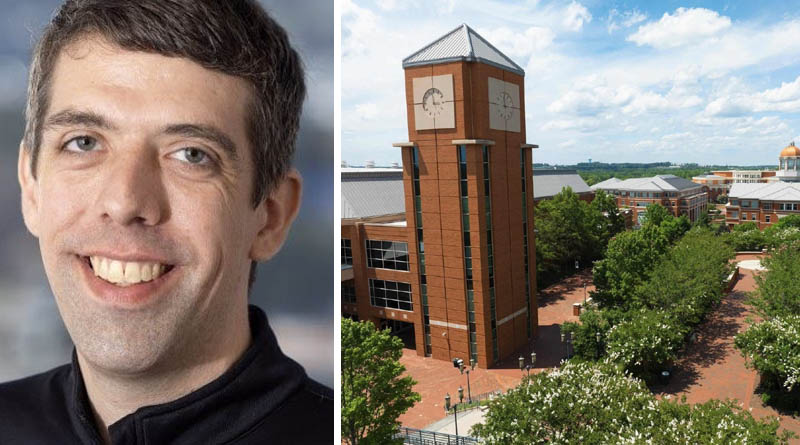
Charlotte’s Keith Burghardt Is Developing Data-Driven AI Models To Counter Misinformation Online
From unraveling the laws of physics to tackling the complex challenges of misinformation and online fraud, Keith Burghardt’s academic journey reflects a deep curiosity about how systems—both physical and social—work at their core. Today, his research sits at the intersection of data science, machine learning, and social impact, with a focus on understanding and reducing the harms of digital platforms.
From Physics to Social Networks
Burghardt’s early academic passion was rooted in physics, where he was fascinated by the idea that simple equations could explain complex phenomena—from a falling ball to the collapse of a star. That mindset shifted when he discovered network science, a field that applies similar principles to human interactions. By modeling relationships and behaviors as networks, he began exploring how online interactions could be studied systematically.
As social media rapidly expanded in the early 2010s, Burghardt noticed troubling patterns: rising radicalization, widespread scams, and increasing manipulation. This observation reshaped his research goals, leading him to develop advanced, data-driven AI models to better understand—and ultimately counter—extremism and misinformation online.
A Physics Mindset in Data Science
Burghardt’s background in physics continues to shape his approach to machine learning. He emphasizes simplicity and clarity, often asking, “Can we do this with less?” Rather than defaulting to highly complex models, he advocates for streamlined, explainable tools that reveal the core patterns in data.
Whether analyzing social media trends or detecting fraud in industry settings, he prioritizes efficient algorithms with low technical complexity. While he acknowledges the value of advanced AI systems, he believes simple models can often be more powerful for targeted, real-world applications.
Understanding Misinformation and Extremism
The COVID-19 pandemic served as a turning point in Burghardt’s research focus. Witnessing the rapid spread of fringe rhetoric and misinformation, he became driven to understand why individuals adopt such beliefs. His work now explores how online environments contribute to extremism—and how these digital behaviors can spill over into real-world consequences.
One of his most surprising findings is the ability to predict, more than a year in advance, which users are likely to promote certain types of misinformation, such as anti-science narratives. This suggests that deeper, underlying factors influence susceptibility—an area his ongoing research aims to uncover.
The Role of AI in a Changing Landscape
As AI tools become more advanced, Burghardt notes that misinformation and fraud are becoming increasingly convincing. From AI-generated images to realistic text and video, bad actors now have powerful tools at their disposal.
However, he sees this as part of an ongoing “cat-and-mouse” dynamic. Just as malicious techniques evolve, so do detection methods. His lab is actively developing tools capable of identifying harmful content despite these advancements, while also exploring how AI can help “inoculate” users against misinformation through targeted interventions.
Academia vs. Industry
Having worked in both academia and industry, including roles connected to major institutions and companies like Amazon, Burghardt highlights a key difference: speed versus exploration.
Industry prioritizes rapid development and deployment, often driven by competitive pressures. Academia, on the other hand, allows for long-term, high-risk research that can lead to groundbreaking innovations. He sees these environments as complementary—industry drives immediate impact, while academia pushes the boundaries of what’s possible.
Teaching the Next Generation
In his Fundamentals of Machine Learning (DTSC 8120) course, Burghardt prepares students for the evolving demands of the AI landscape. He balances foundational concepts with hands-on applications, teaching students how to build neural networks using Python while also integrating modern tools like large language models (LLMs).
His goal is to equip students not just with technical skills, but with the ability to adapt—showing them how emerging technologies can be used in ways that were unimaginable just a few years ago, such as generating new signals for fraud detection or gaining deeper insights into language.
Research with Real-World Impact
Burghardt’s work has gained national attention, being featured in major outlets like The New York Times and Wired. He describes this recognition as humbling, emphasizing the collaborative nature of his research and the contributions of colleagues and students.
For him, the most rewarding aspect is not the recognition itself, but the public interest in research that addresses pressing societal challenges.
Advice for Students
For students considering careers in data science and social impact, Burghardt offers both practical and philosophical advice. While acknowledging concerns about job market fluctuations, he stresses that data science skills are becoming essential across industries and are likely to remain valuable.
Equally important, he highlights the opportunity to make a meaningful difference. Data science is not just a lucrative field—it’s a way to contribute to solving real-world problems.
His key recommendation: master the fundamentals while staying current with emerging tools. By continuously revisiting core concepts, students can better understand new technologies, identify opportunities for innovation, and apply their knowledge effectively in both research and industry.
Through his work, Keith Burghardt demonstrates how technical expertise can be applied to some of society’s most urgent challenges—bridging the gap between theory and impact in an increasingly digital world.